01
Corner entry
Increase suction under braking and bias discharge to sharpen turn-in and stabilize yaw.
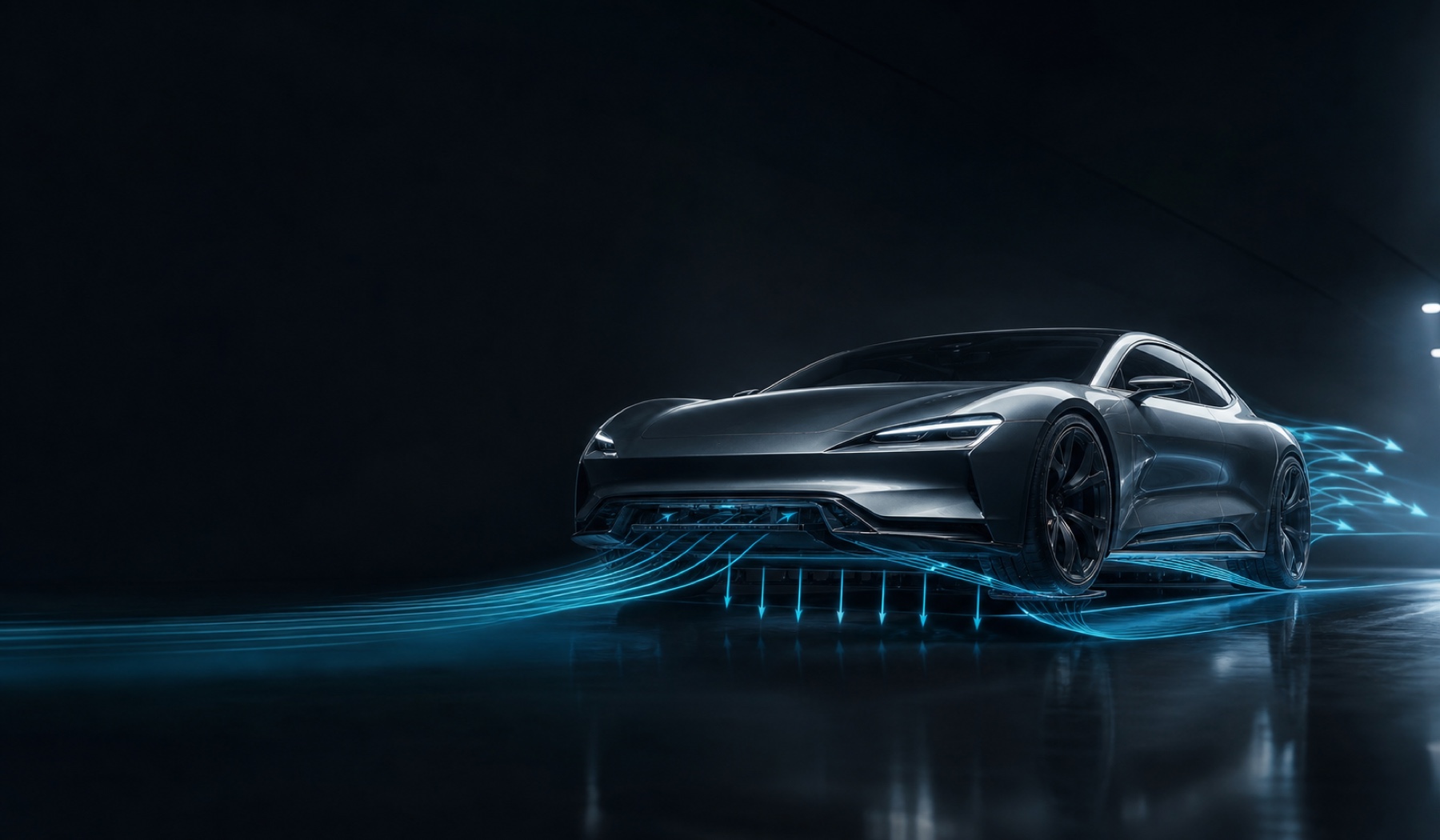
Patent application filed. Vehicle Active Aerodynamics and Dynamics Control via Flow Vectoring.
Grip from pressure.
Stability from flow.
A coordinated EV architecture creates underbody suction, vectors the discharged air, and routes available regenerative energy into a fast new dynamics actuator.
Explore the architectureThe limitation
Moving surfaces can shape drag and downforce, but they have limited authority for fast, side-to-side vehicle control. At the same time, regenerative power may be reduced when the battery cannot accept it.
The shift
Fan-driven pressure and directional discharge create a rapid aerodynamic actuator—then join dynamics, braking energy, and thermal constraints under one supervisory controller.
Pull downLower underbody pressure to increase tire load when grip matters.
Point the flowBias discharge by direction to support yaw, roll, pitch, or drag.
Use available energyConvert constrained regenerative power into aerodynamic control.
The architecture
A fan array draws from the underfloor plenum. A network of ducts and fast directional outlets turns the same mass flow into both vertical load and controllable moments around the vehicle.
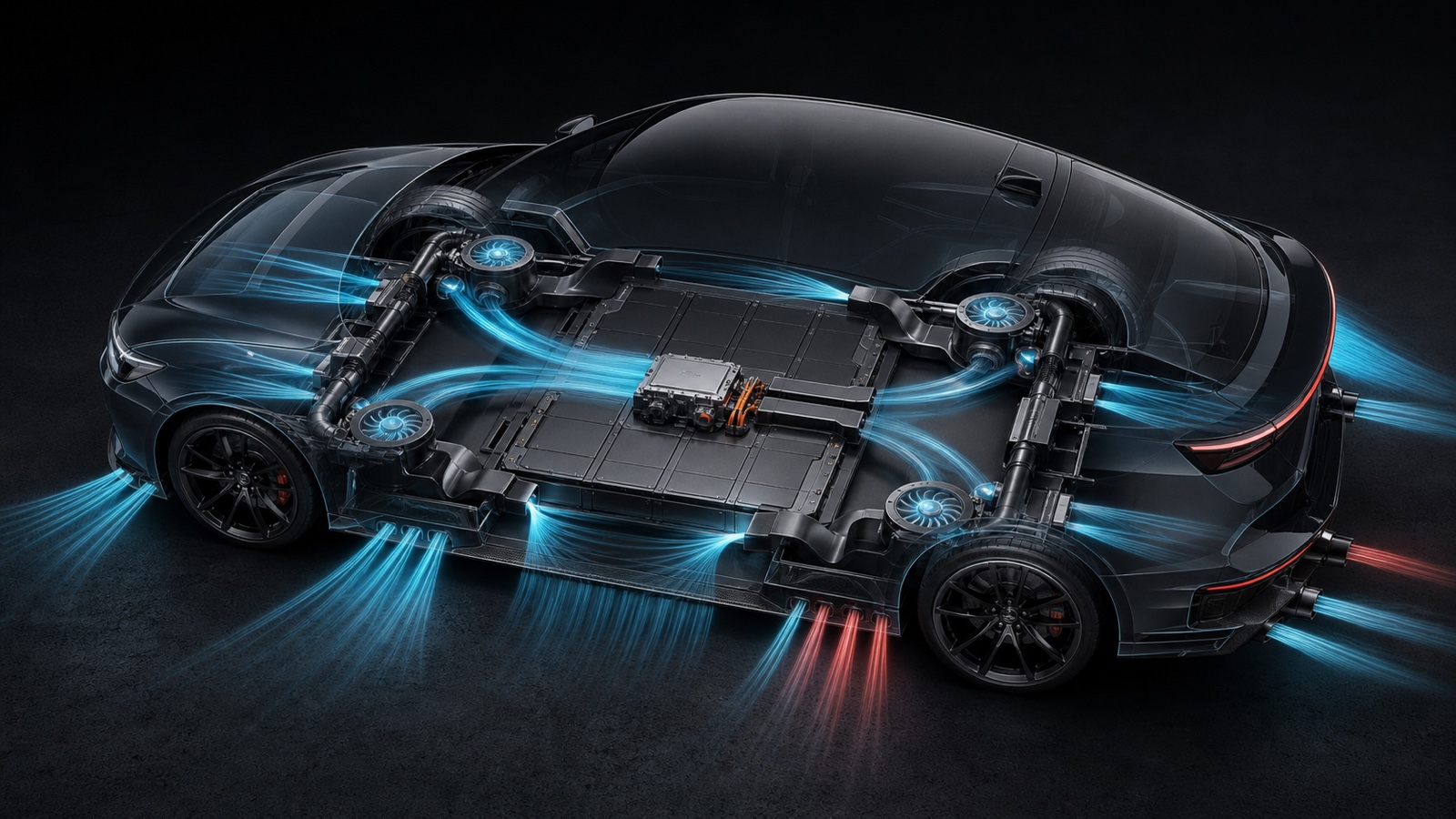
Fans pull air from the underfloor plenum to add tire load independently of vehicle speed.
Manifolds and fast valves send flow to front, rear, left, or right outlets on demand.
Nozzles, vanes, or multi-slit selectors translate flow into yaw, roll, pitch, downforce, or drag.
Available regenerative power drives the fans; spin-down can return part of their rotational energy.
Dynamic behavior
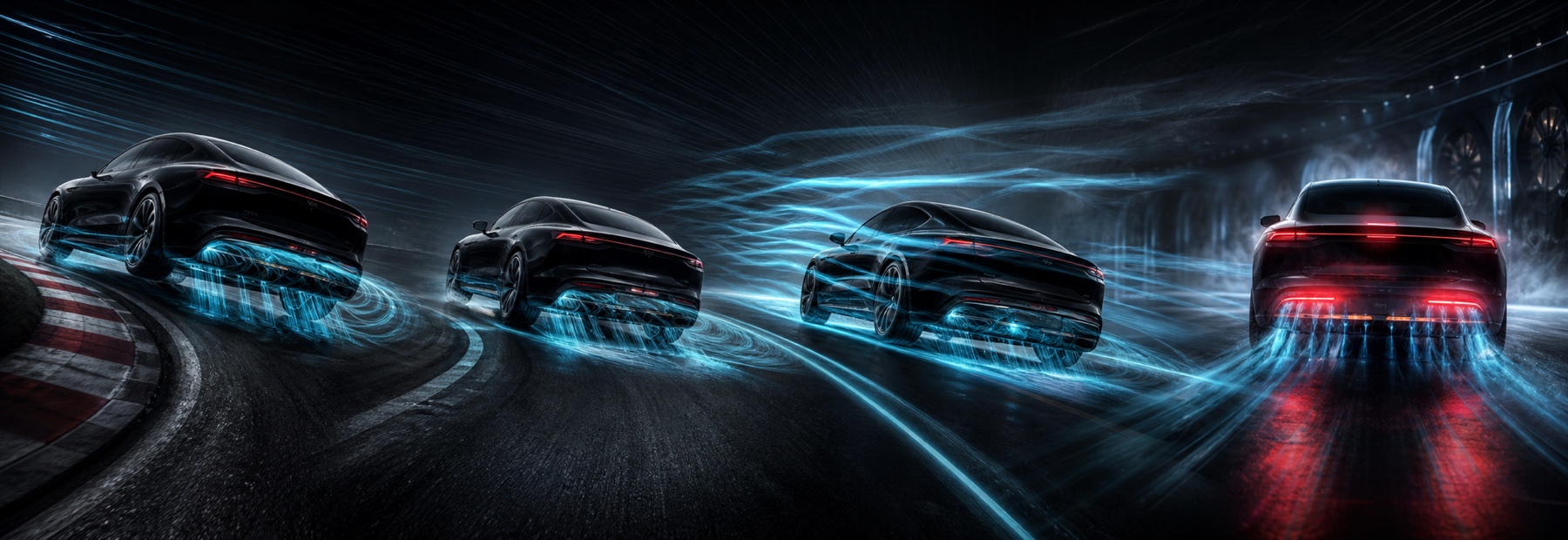
The controller changes fan load and discharge direction continuously, trading grip, response, stability, and efficiency as the maneuver evolves.
01
Increase suction under braking and bias discharge to sharpen turn-in and stabilize yaw.
02
Reduce fan demand to limit drag while preserving the flow that supports traction.
03
Apply asymmetric lateral vectoring to counter disturbances before they grow.
04
Pair maximum useful suction with drag-oriented discharge for stable heavy braking.
Coordinated control
Yaw rate, wheel speed, steering, slip, wind, friction, battery acceptance, and thermal limits enter one multi-objective decision. The system asks for only the pressure and flow the vehicle can use.
Fuse vehicle motion, driver intent, road grip, wind, and energy availability.
Balance grip, stability, efficiency, thermal limits, noise, and drivability.
Work with ESC, brake-by-wire, and torque vectoring instead of acting in isolation.
Reduce fan speed gracefully and regenerate part of the stored rotational energy.
Integrated hardware
Active Aero Flow Vectoring turns moving air from a passive by-product into a precise vehicle dynamics tool.
Patent application filed.