What it is
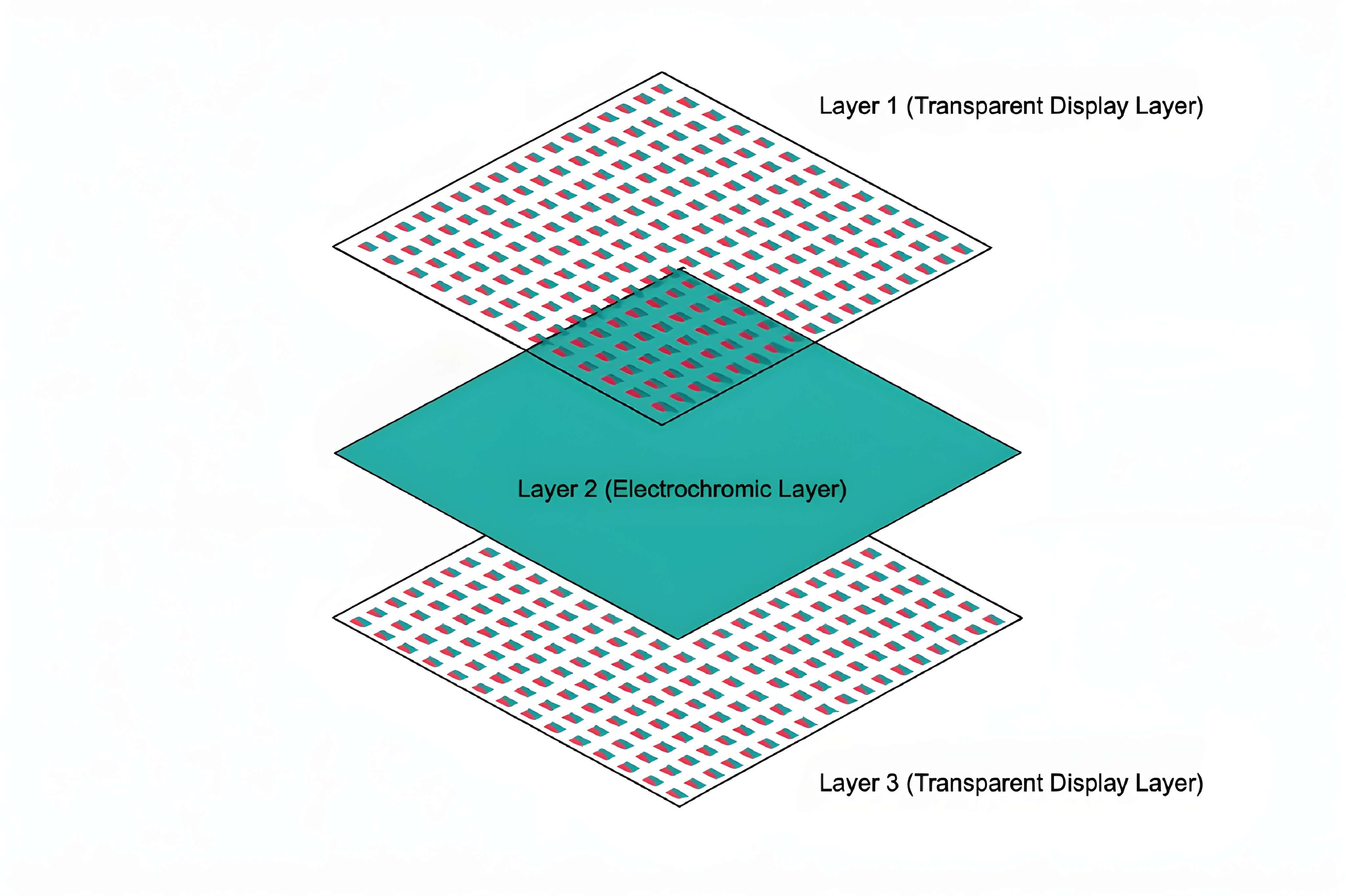
This patent describes a multi-layer display device, a transparent panel that can project imagery on both sides while controlling how much light passes through the structure.
In practice, the panel can act as a regular window, a dual-sided screen, or an opaque barrier for privacy and sunlight blocking. The concept is intended for vehicles, buildings, and smart architecture where transparency and information display need to coexist.
The problem
Conventional displays struggle in environments where visibility, information, and privacy all need to change in real time.
- Most displays are still single-sided.
- Traditional setups cannot manage dual-sided viewing and tunable opacity without multiple separate devices.
- Emerging use cases need different information on each side while preserving outward visibility or blocking light on demand.
The solution: a layered approach
The invention uses a stacked arrangement of transparent layers to create a more versatile panel.
The core layers
- First transparent display layer for one viewing direction
- Transparency control layer in the middle, using smart-glass behavior to switch between clear, opaque, and partial states
- Second transparent display layer on the opposite side for independent or synchronized content
Construction details
The full stack can include inner and outer glass, optical adhesives, and optional air-gap or gas-filled layers for insulation. Pixels on the two display layers can overlap closely to maximize transparency or brightness.
Smarter control by zones
For precise operation, the layers are divided into controllable sections.
- Display layers are split into many smaller zones for high-resolution imagery.
- The transparency layer uses fewer, larger zones that overlap with groups of display zones.
This allows hybrid states where one region can show information while the rest of the panel remains transparent.
How it works
A central controller sends signals to each layer based on user needs or sensor inputs.
| Mode | Description |
|---|---|
| Independent dual-screen | The middle layer becomes opaque and different content appears on each side. |
| Enhanced brightness | The middle layer stays transparent while both screens show the same image with overlapping pixels. |
| Transparent mode | The displays turn off and the middle layer goes clear for a standard window view. |
| Privacy or sun block | The middle layer turns opaque to block views, glare, or sunlight. |
In vehicles, the system can integrate with speed, temperature, and navigation signals to display contextual information. More advanced versions can even track passenger gaze to selectively show external views or data.
Extra capabilities
- Optional extra transparency layers for better sunlight protection and thermal efficiency
- Optics such as lenticular lenses for depth effects
- Opaque modes that reduce the brightness required from the screens, extending their lifespan
- Gaze tracking that can show external camera views only where the user is looking
- Automatic blocking of sunlight before it reaches sensitive layers
Where it fits
- Vehicles, replacing windows, sunroofs, or partitions with contextual displays
- Buildings, where facades can show internal schedules and external promotions while managing light and privacy
- Public transport, interactive billboards, and retail displays
Benefits
- True dual-sided viewing with tunable transparency
- Energy efficiency through synchronized layers and lower brightness requirements
- Protection from sun damage in opaque modes
- Fine-grained customization through zoning and context-aware control
- Practical construction aligned with existing bonding and insulation techniques
What the patent covers
- The stack structure of two transparent display layers with a transparency control layer in between
- Pixel alignment for higher transparency and brighter synchronized states
- The mapping between multiple display zones and larger transparency zones
- Control logic that coordinates content display with transparency changes