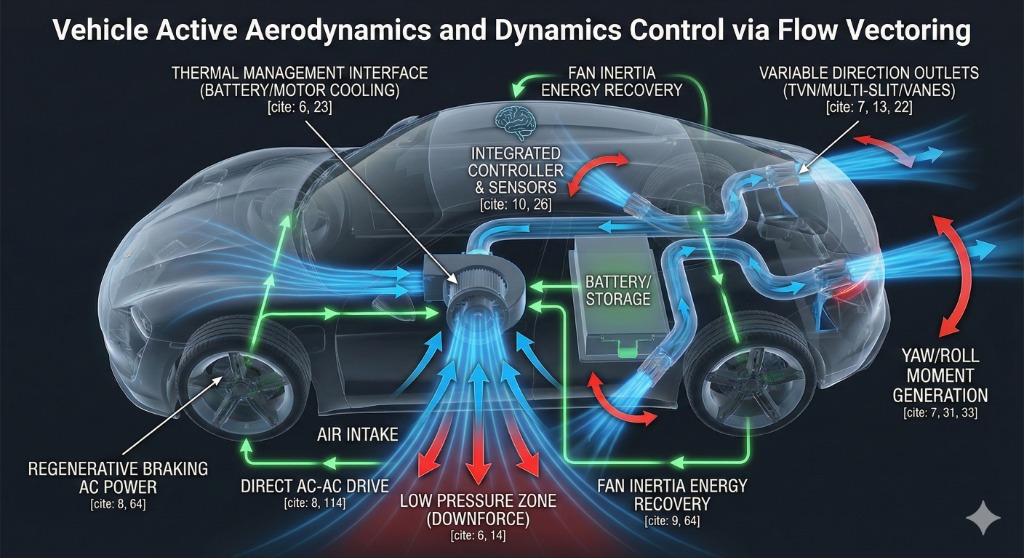
Patent Application Filed. Title: Vehicle Active Aerodynamics and Dynamics Control via Flow Vectoring
One-Line Idea
Use controllable fans to create underbody suction for grip, then vector the discharge airflow to support yaw and stability, while opportunistically powering the system with regenerative braking energy.
Why This Problem Matters
Modern vehicles already use active aero and ESC/torque vectoring, but the systems are often separate and leave performance on the table:
- Active aero surfaces are effective, but rapid side-to-side aerodynamic moment control is limited.
- EV regenerative power can be temporarily curtailed when battery charge acceptance is constrained (SOC, temperature, health, or transient limits).
- Aero, thermal, and stability systems are usually optimized independently rather than as a single coordinated controller.
System Concept
1) Underbody Suction for Grip
Fans/blowers/compressors pull air from the underfloor or plenum, lowering pressure beneath the vehicle. Lower underbody pressure increases vertical tire load and helps grip during braking and cornering.
2) Airflow Vectoring for Vehicle Balance
Instead of dumping that airflow passively, the discharge is routed through controllable outlets:
- thrust-vectoring nozzles
- multi-slit selectors
- movable vanes/flaps or equivalent flow-direction devices
By controlling discharge direction (left/right/front/rear/up/down), the system can add useful yaw, roll, pitch, downforce, or drag effects as a complement to brake and torque vectoring.
3) EV Energy Routing During Regen
During braking, regenerative motor power can drive the fan system when battery acceptance is limited. Candidate power paths include:
- direct AC-AC routing with synchronized switching (matrix-converter style)
- minimal DC-link architecture where appropriate
This converts curtailed regen opportunity into controllable aerodynamic benefit instead of simply reducing regen request.
4) Fan Spin-Down Energy Recovery
When fan speed is reduced, the motor can switch to generator mode and return part of the stored rotational energy to the traction bus or storage (battery/supercapacitor), depending on platform constraints.
Example Driving Behavior
| Scenario | Typical Control Action | Intended Effect |
|---|---|---|
| Corner entry (brake + turn-in) | Use available regen power to spin fans, increase suction, bias discharge for turn-in support | More entry grip and cleaner yaw response |
| Corner exit (acceleration) | Reduce fan load to limit drag, bias rearward/downward as needed | Preserve traction and efficiency |
| High-speed straight / crosswind | Apply asymmetric lateral vectoring to counter disturbance | Better straight-line stability |
| Emergency decel | Increase suction and use drag-oriented vectoring where useful | Added stability under heavy braking |
High-Level Building Blocks
- Gas moving device: fan/blower/compressor (single unit or distributed array)
- Underbody geometry: skirts, plenum, diffuser (optionally adjustable)
- Ducts and manifolds: route flow to front/rear/left/right outlets
- Fast valves and anti-backflow strategy for stable routing
- Vectoring outlets: TVN, multi-slit, vanes/flaps, or equivalent
- Optional thermal coupling with battery/motor/inverter cooling loops
- Power electronics for regen-to-fan routing, synchronization, and protection
- Supervisory controller integrated with ESC, brake-by-wire, and torque vectoring
Control Philosophy
The control target is multi-objective, not single-metric:
- grip/downforce
- drag/efficiency
- yaw-roll-pitch stability
- thermal constraints
- noise and drivability
Sensor fusion (yaw rate, slip estimate, wheel speeds, steering, wind disturbance, friction estimate) and predictive context can be used to act before instability grows.
Why This Is Different
Compared with conventional active aero, this concept:
- uses directed airflow as a fast control input, not only moving surfaces
- couples aero control with EV energy-routing logic
- can recover part of fan rotational energy during spin-down
- is designed as one coordinated dynamics-energy-thermal strategy
Short Card Version
Flow Vectoring Active Aero (Concept)
An integrated EV-focused control architecture that creates fan-driven underbody suction for grip and vectors discharge airflow to support yaw/roll/pitch stability. It can opportunistically use regenerative braking power when battery acceptance is limited, and recover part of fan inertia during spin-down through generator operation.